

If you want to do something that is at once mildly amusing and at the same time will freak you out a bit, try this.
Upload a picture of yourself to your preferred AI platform and give it the following prompt. Tell it to change one feature of your face. Pick whatever you wish. You might tell it to change the shape of your nose. Or its size. You might tell it to pull your eyes slightly closer together or change the shape of your lips.
The resulting image will mess with your mind! I’ll tell you why in a moment but first let me explain my experience.
Susan and I were working on cover ideas for our soon-to-be-released book, Anxiety… and how to conquer it. And we wanted to include a picture of yours truly on the back cover.
Despite the fact that we told Chat to leave the photo completely unchanged, apparently it just couldn’t resist. (LLMs are not as “smart” as we think.)
One rendering had me with an “ear to ear” smile showing practically every tooth in my head.
I’ve never smiled like that in my life folks.
That picture really messed with us… and now we come to the reason yours will mess with you as well, should you try this little experiment.
The picture, you see, almost looked like me.
That night in bed I was reflecting on this experience and it brought a passage of Scripture to mind.
I tell you this, brothers: flesh and blood cannot inherit the kingdom of God, nor does the perishable inherit the imperishable. Behold! I tell you a mystery. We shall not all sleep, but we shall all be changed, in a moment, in the twinkling of an eye, at the last trumpet. For the trumpet will sound, and the dead will be raised imperishable, and we shall be changed. For this perishable body must put on the imperishable, and this mortal body must put on immortality. When the perishable puts on the imperishable, and the mortal puts on immortality, then shall come to pass the saying that is written:
“Death is swallowed up in victory.”
“O death, where is your victory?
O death, where is your sting?”[i]
While we who have responded to the Gospel invitation of Jesus walk about in our day-to-day lives, we almost look like ourselves. Almost, but not quite.
The difference is both quantitative and qualitative. Because once we are “changed,” we will be so much more (complete) but also so much better (a perfect creation).
Our passage tells us this present body is mortal and that it is perishable. That is a more pleasant way of saying it dies and it decays.
But wait till you see how we end up! We will have a body impervious to that great enemy of life. Death.
We are promised that in the coming world we will have a body that cannot die and cannot decay. A reality purchased for us by the atoning sacrifice of Jesus. A reality that includes a body both glorious and eternal.
Then and then only will I look as I was meant to look. Then and then only will I look fully like me. Then and then only will you look like you.
What are some practical implications of this reality? There are surely more, but I would suggest three.
First, we ought to be kinder to ourselves. I don’t mean we should pamper ourselves more or be more self-indulgent. I mean kinder. Which is an aspect of the fruit of the Spirit, by the way.[ii]
I am into my third decade as a psychotherapist and counselor. I can categorically tell you that I see very little difference between the internal dialogue of a Christian when compared to that of an unbeliever. Generally, it is every bit as toxic and serves only to beat the individual down. A toxic inner dialogue wounds and limits.
Disabling self-talk is the psychological term for this practice.
Second, we should be more gracious to our fellow believers. To everyone certainly, but especially our brothers and sisters in Christ. That’s biblical, you know. Paul admonishes us with these words, “Therefore, as we have opportunity, let us do good to all people, especially to those who belong to the family of believers.”[iii]
Remember, they don’t quite look like themselves yet either. Almost, but not quite. He or she will one day be all they were made to be. But they aren’t there yet. And it’s sometimes obviously so... just like you and me.
That’s why we’re encouraged to be patient with one another.[iv]
Lastly, I encourage you to take hope in that great day of which our passage speaks. We will one day be new people in new bodies! Perfect people in perfect bodies!
The body, the person that is susceptible to decay and death... the body that stoops with age and twists with disease and damage will be long gone.
Our spiritual struggles and psychological brokenness will be a thing of history.
The Bible calls the day this will occur our “blessed hope,” and ties it to the return of Christ.[v]
And we should be excited about this truth!
Just as Jesus was completely recognizable as Himself after the resurrection, so too will we be. But until that great day I have to content myself with almost looking like me. Just as you have to with almost looking like you.
Can you imagine what it’s going to be like on that great day when we see each other for the first time... really see each other as God intends us to be?
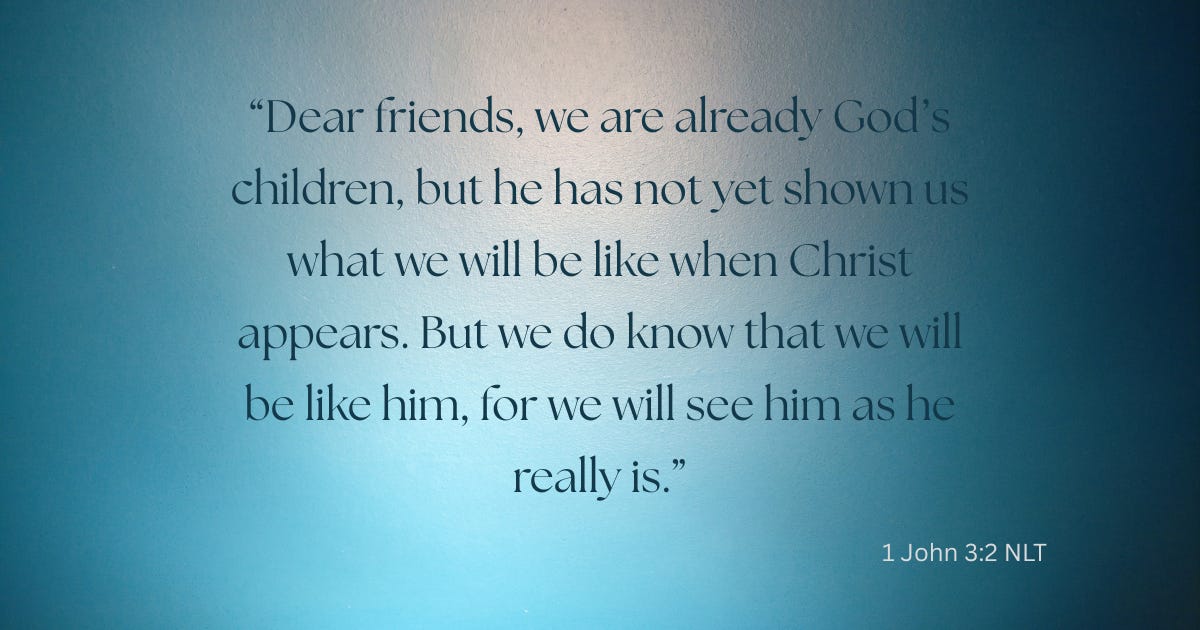
Little wonder that John tells us, “Beloved, we are God’s children now, and what we will be has not yet appeared; but we know that when he appears we shall be like him, because we shall see him as he is.”[vi]
I wouldn’t be surprised if, on that day, we look at faces so well known to us in this present life and say, “Oh my! So that’s what you really look like!

[i] 1 Cor 15:50-55, ESV.
[ii] Gal 5:22-23, ESV.
[iii] Gal 6:10, NIV.
[iv] 2 Tim 2:24, NKJV.
[v] Titus 2:13, NKJV.
[vi] 1 John 3:2, ESV.
At first, I was hesitant 🤣 I’ve seen the AI me and I don’t like her. She’d slightly…odd. But then, where you went with the principle is so tangible! We are “almost, but not quite yet” ourselves true selves. That perspective invites patience and gentleness with ourselves and others. And then to ponder how glorious that day will be when we stand in His glory, as He designed us! Oh, the beauty!! Thank you!