

In this new series we’re going to explore three prayers of well-known Christians of the past. We are meditating on these prayers for the wisdom found in them... and the application we can glean from them for our own lives.
We begin with a prayer of Augustine:[1]
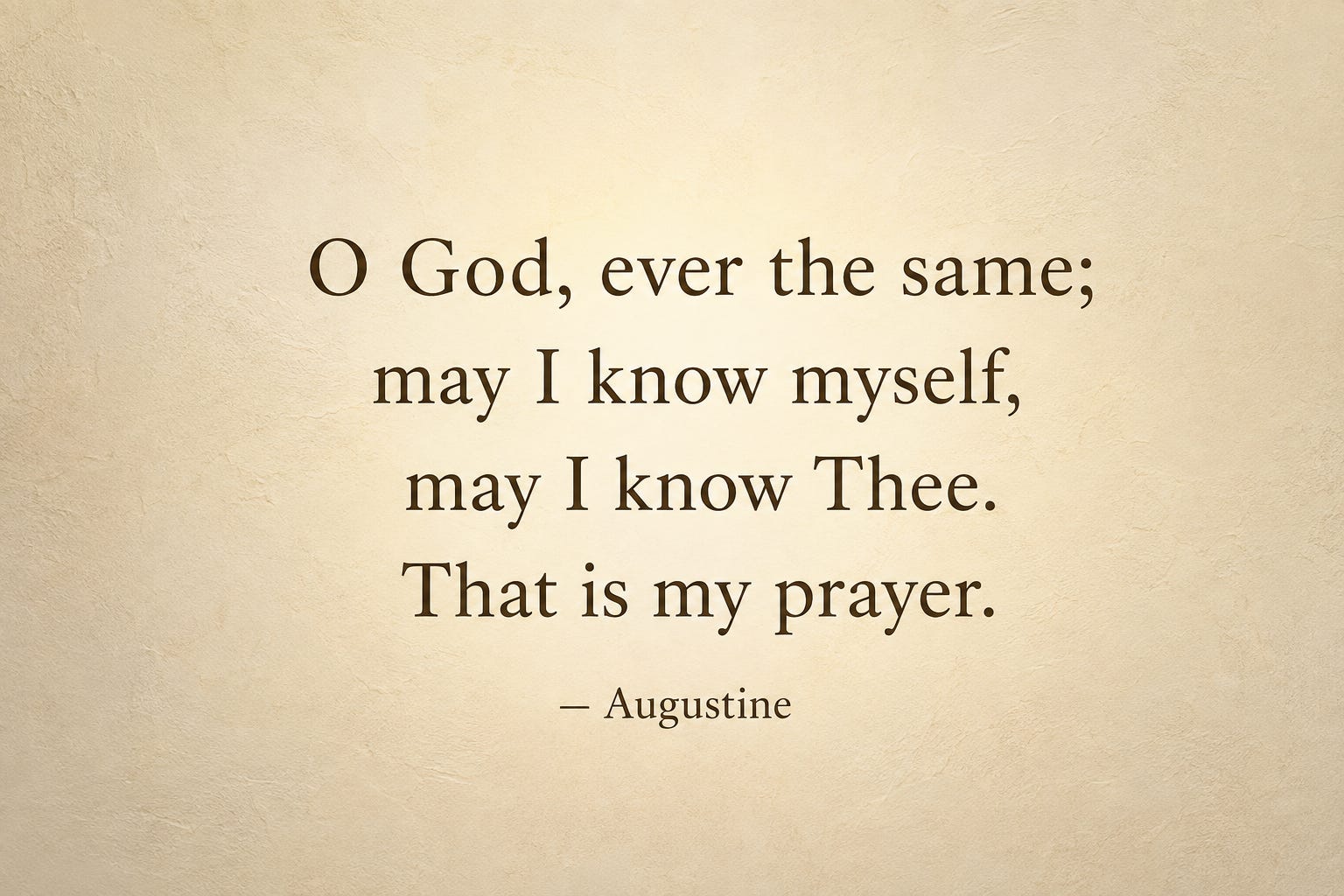
I call Augustine’s prayer holistic because it urges us toward an understanding of both who we are and who God is. Many Christians claim a vigorous pursuit of the latter while demonstrating a fearful avoidance of the former.
And yet true spiritual growth cannot exist apart from at least a modicum of self-awareness and self-understanding. The Scriptures tell us to “deny ourselves” in favor of the cross. It never once encourages us to be ignorant of ourselves.
I’ve no doubt Augustine had the Delphic maxim “know thyself” in his mind as he prayed this prayer.
You will notice in all our materials that Susan and I have a preference for the term psychospiritual. This is because as far as the inner life of a person goes, that term is comprehensive. Holistic. It recognizes that we are both spiritual beings and psychological beings – the latter being concerned directly with the mind... and the emotions and behaviors which emanate from it.
Let’s see what we can observe from Augustine’s very wise prayer in which he asks God to give him the ability to know himself.
Looked at psychologically, we could say there are two aspects of a person – we are a self... and we have a story.
On the psychological level, most of our inner struggles come from aspects of our self, our story – or both – that we have yet to make peace with.
We must be careful not to use ostensibly spiritual pursuits in an attempt to gloss self-work.
A woman told me of having been raped as a teenager. But she was in utter denial of the impact this horrible experience had on her, historically using the defense mechanism of rationalization to suppress the experience. And yet she was on an anti-depressant.
For two decades she had tried to ignore her past trauma by focusing intently on her spiritual development. (She was a dedicated follower of Christ.) It wasn’t working.
Spiritual healing cannot take place around psychological wounds that we aren’t willing to bring to the light.
When Nathan the prophet confronts David, he takes him straight to the king’s self (his lust) and his story (taking Bathsheba and essentially murdering her husband, Uriah). Self and story.
In our understanding of the Master’s scathing words to the pharisees in Matthew 23:27-28, I think we fail to make a useful application. You may recall that, in that passage He blasts the pharisees of being phony. “Hypocrites.”
As such, He goes directly to their intent. They cared nothing about being righteous. They only wanted to look spiritual.
However, if we step away from intent and look at consequence, I think there is something here of much value for us as believers. If we do not allow the Word to illumine us (remember, it is a light[2]) and show us areas of our self or our story that need healing or change, what becomes of those encounters with the Word? There is nothing they can do but lay on the surface of our life.
Like a coat of paint.
I think this goes far in explaining the sad state of the American church today. We are not bringing our self and our story to the Word where the Holy Spirit can use it to bring real and lasting healing and change to our life. Consequently, our brokenness and need get trapped within us.
This creates its own kind of whitewashed tomb. Much different from that of the pharisees. But every bit as real.
Augustine is not the only voice from the past to pray for self-understanding, by the way. Centuries earlier Polycarp – who was personally discipled by the Apostle John – prayed the following, “Lord, help me to face the truth about myself.”[3]
I want to turn now to the second half of Augustine’s prayer.
“...may I know Thee.”
Please don’t take my brevity here as my being dismissive or cavalier about this part of the prayer. The reason I spent the bulk of time addressing the first half of Augustine’s prayer is because of the extent of neglect among believers in this area.
Saying that, it is essential that we pursue a deeper... a growing understanding of our Lord.
God does not need us to seek Him. But He does deeply desire it. That fact alone should compel us to seek Him out in love. You will seek Me and find Me, when you search for Me with all your heart, says Jeremiah. (29:13)
Our Lord not only wants us to seek Him... according to the previous passage... He wants us to find Him! It is in this searching and finding that, to use Augustine’s words, we come to know Him.
This seeking and finding was so important to the Apostle Paul that he penned these words: Indeed, I count everything as loss because of the surpassing worth of knowing Christ Jesus my Lord. For his sake I have suffered the loss of all things and count them as rubbish,....[4]
What does this pursuit of God, as Tozer called it, look like? We should desire... and pursue... knowing God like a thirsty deer in a drought looks for and craves water: As the deer longs for streams of water, so I long for you, O God. I thirst for God, the living God.[5]
In closing, I would suggest that we should not only know Augustine’s prayer, but that we would be wise to pray it as well.
O God, ever the same; may I know myself, may I know Thee. That is my prayer.

[1] Augustine, Soliloquies: 2,1.
[2] Psalm 119:105.
[3] See https://acollectionofprayers.com/tag/polycarp/.
[4] Philippians 2:8.
[5] Psalm 42:1-2a.
Christians Who Thrive brings together timeless biblical truths with psychological wisdom that equip you to replace the pain and frustration you now carry with personal, spiritual, and relational experiences you long for. ©2026 Growth Resources LLC | Christians Who Thrive. All Rights Reserved.
Love this! God led me to my writing journey a few years ago. I love what He has done and continues to do through my books, When Jesus Calls and When Jesus Leads as we share our story. Reflecting has brought much healing and a deeper relationship with Him. I am currently writing the 3rd book in the series. It’s almost complete. While writing, God has brought pain that had been buried deep in my heart and while healing our hearts, He is using all of it to touch others for His Glory! May God bless you both as you keep talking and pointing people to Jesus. May our testimonies be used for His Glory as we walk in His will, not our own. 🤍🕊️. For His Glory! John 11:40
Martha Gayle ❤️
I wish I’d had this knowledge BEFORE life turned upside down 3.5 years ago. You’ve described it so beautifully here. My hope is that people will find this article, head its advice, and wrestle with self, story, and Scripture. Because the healing that comes on the other side of psychospiritual growth is sooooo worth the effort.