

Jesus came to sanctify the ordinary … to transform our mundane, day-to-day existence into something vibrant and wonderful, as His first miracle shows. This journey begins with salvation – our coming into a personal relationship with Christ by faith.
But that’s just the beginning. He offers us more, so much more than just a new birth. He wants to transform us ... just as He transformed water into the very best wine in our passage.
So far in this series we have seen that this miracle shows our great need. We have also seen that it reveals Christ’s deep care and concern for us.
Today we move on to our third consideration from this passage:
This Miracle Reveals the Necessity of Obedience
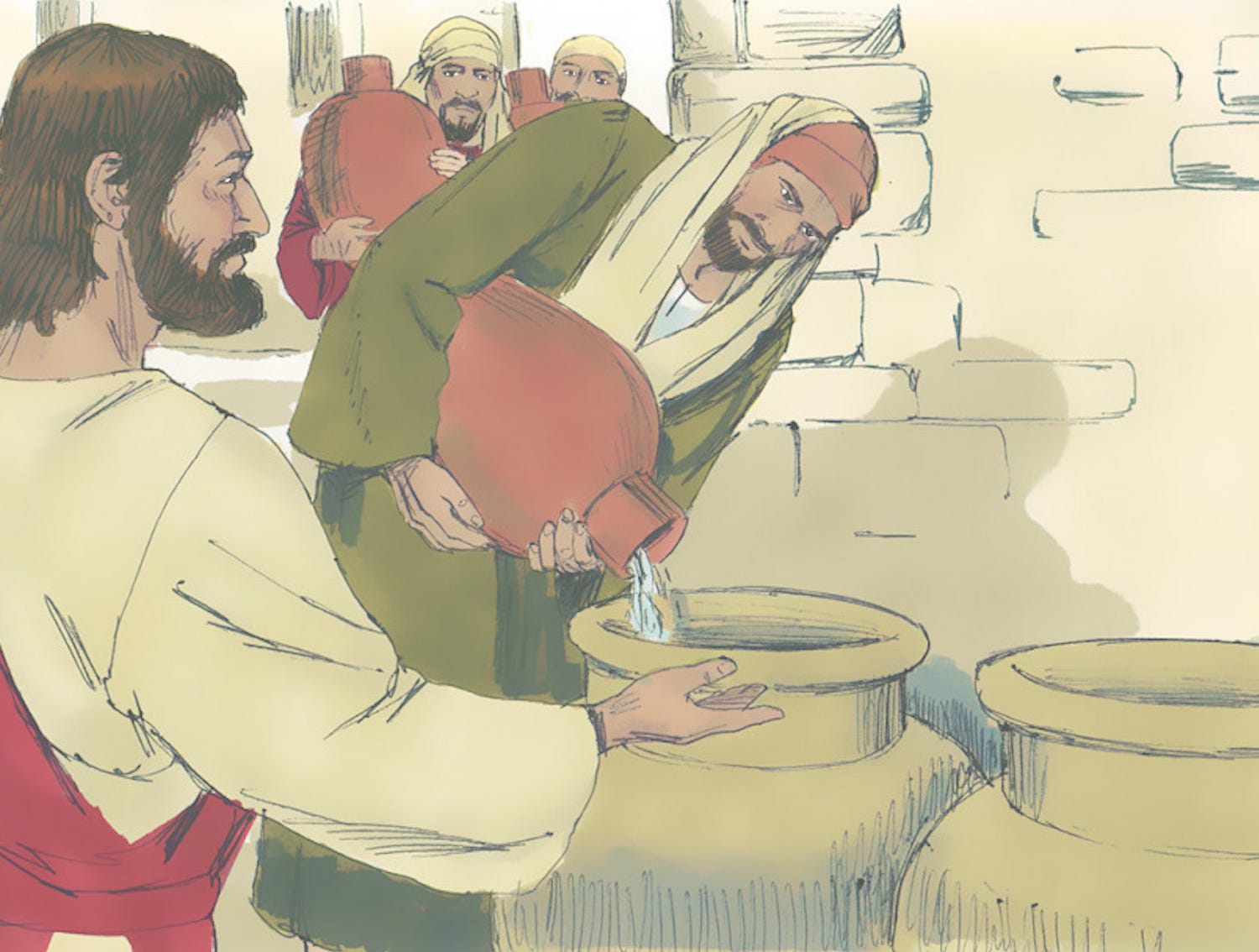
Jesus said to the servants, “Fill the jars with water.” And they filled them up to the brim. And he said to them, “Now draw some out and take it to the master of the feast.” So they took it. (verses 7-8)
It intrigues me to think that this, the very first of our Lord’s miracles, would likely have never occurred had the servants at the wedding feast not obeyed His instructions.
And note there were no half-measures on behalf of the servants. The Master told them to fill the water jars and they “filled them up to the brim.” There was no thought in their minds of doing just enough, it seems …
… even though, humanly speaking, this command made no sense. The wedding hosts were in need of wine … not water!
What an unforgettable experience the attendees at the wedding would have missed out on had the servants stopped to ponder the reasonableness of the Lord’s command and then debated about whether or not they would do what He said.
We can learn from such obedience.
I believe there is so little spiritual power amid the body of Christ in America because we have turned the reign of Christ into a constitutional monarchy. We call Him king and lord, but He holds little more than ceremonial power in our actual lives. Much like King Charles, the constitutional monarch of the United Kingdom, we bring Him out on ceremonial occasions and special days (like Christmas and Easter), but He exercises no real power in our daily lives.
Christ made no such offer to us. To the contrary He asks, “Why do you call me ‘Lord, Lord,’ and not do what I tell you?” (Luke 6:46)
His point is a clear one, is it not? You have no right to call me Lord if you do not obey me.
I am glad that the servants at the wedding obeyed. There would have been no miracle without it.
I am reminded of another account in Scripture when the Lord gave a command that, humanly speaking, made no sense. You can read about it in Exodus 14.
The children of Israel have left Egypt after 400 years of bondage. They are traveling toward the promised land with pharaoh’s army in pursuit. They get to the shore of the Red Sea and they panic because they are trapped – Egypt’s army behind them, the Red Sea in from of them.
Their leader, Moses, cries out to God and receives a most confounding command in response. God says to Moses – “Go forward.”
How in the world are they supposed to do that? Nevertheless, they obey. And God parts the sea!
If we want to experience God transforming our every day, ordinary life into something extraordinary it is imperative that we remember an essential point of the miracle of His turning water into wine:
The miracle lies on the other side of obedience.
Til next time,
