

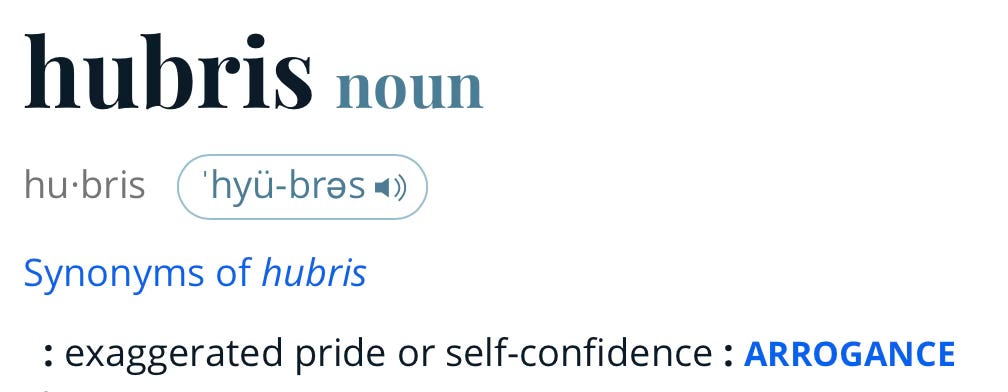
If you have your ear attuned to current conversation and literature, you’ve likely heard or read the word hubris a few times. Hubris is the Greek word for pride. But you may not be as familiar with the Latin term for the same malady; the Romans referred to pride as superbia.
The sixth century Roman church leader, Gregory I, said that pride [superbia] is where man “favours himself in his thought; and . . . walks with himself along the broad spaces of his thought and silently utters his own praises.”*
In His personification as wisdom, God says in Proverbs 8:13 that He “hates” pride. That’s serious business!
Given that, we are wise as believers to consider superbia ... and to see how our lives are affected by it.
To that end I want to look briefly at three areas important to our spiritual growth where pride can hinder our progress.
1) Dependency
Regarding spiritual growth, the Master Himself says “apart from me you can do nothing.” (John 15:5)
Pride dismisses this reality.
The apostle Paul tells us, “Not that we are adequate in ourselves to consider anything as if it were coming from ourselves, but our adequacy is from God.” (2 Corinthians 3:5)
Pride ignores this truth.
2) Declaration
In the regal KJV of the Bible we are admonished to do nothing through “vainglory.” What a great old word! Vainglory is empty glory, worthless glory.
The believer’s glory is empty and worthless when we draw attention to ourselves instead of to Christ. Simply put, we cannot bear witness to Christ and to ourselves at the same time.
3) Development
Pride hinders growth. “God opposes the proud but gives grace to the humble,” James 4:6 tells us.
This is a startling statement! It tells us that if we are governed by personal pride, superbia, God actually becomes our opponent – that’s the very definition of one who “opposes.”
Why on earth would He do this? Isaiah 48:11 gives us the answer. “I will not give My glory to another,” says the Lord.
Pride is serious business. It is nothing less than the violation of the First Commandment where God tells us we are to have “no other gods” above Him.
And pride is a low-rent attempt to do just that. It is the effort to shine a light on ourselves that belongs only to God.
In the next installment of this two-part discussion of pride, we will consider the spiritual and psychological impact of a life lived in pride. That is to say, we will examine what Life in Superbia does to us.
See you then!

*Quoted in Pride: The Seven Deadly Sins by Michael Dyson