

If you are a new Christian or a believer who likes the path simple and the answers easy, you might want to skip this one.
Today we look into the importance of honesty in prayer. And I know of no better example than the following prayer of Teresa of Calcutta. Teresa was a woman who spent her life dedicated to ministering to the “the poorest of the poor” in India.
And though I am by no means in her theological tradition, I do appreciate and benefit from this heartfelt and honest prayer of hers. (The dashes are hers.)
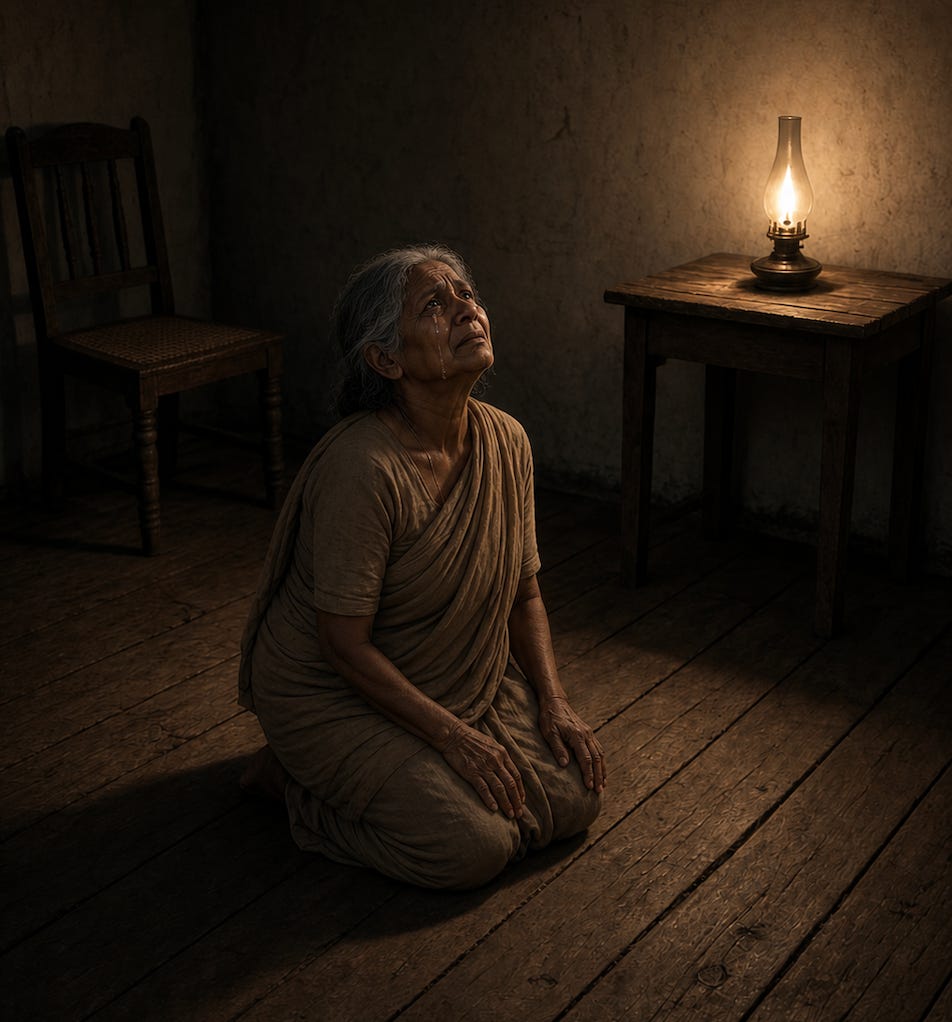
“Lord, my God, who am I that You should forsake me? The Child of your Love — and now become as the most hated one — the one — You have thrown away as unwanted — unloved. I call, I cling, I want — and there is no One to answer — no One on Whom I can cling — no, No One. — Alone.
The darkness is so dark — and I am alone. — Unwanted, forsaken. — The loneliness of the heart that wants love is unbearable. — Where is my Faith — even deep down right in there is nothing, but emptiness & darkness — My God — how painful is this unknown pain — I have no Faith — I dare not utter the words & thoughts that crowd in my heart — & make me suffer untold agony.
So many unanswered questions live within me afraid to uncover them — because of the blasphemy — If there be God — please forgive me… When I try to raise my thoughts to Heaven — there is such convicting emptiness that those very thoughts return like sharp knives & hurt my very soul…If this brings You glory, if You get a drop of joy from this — if souls are brought to You — if my suffering satiates Your Thirst — here I am Lord, with joy I accept all to the end of life — & I will smile at Your Hidden Face — always.”[1]
This prayer is so raw, so plain, so... I’ll say it again, honest... that I need not comment on it at all.
I will only ask this. When such as hers is the true condition of our soul, do you pray that honestly? Do I?
If you say, “But I have never felt such things!” Then I would gently say to you, my friend, I don’t think you’re very deeply connected to yourself or to life, let alone to your relationship with God.
It we cannot relate to this prayer, we may possess width, but it brings into question any notion of depth.
In the most general categorizing, we can say there are three layers of relationship: superficial, casual, and intimate.
There are several characteristics which come together to define these categories. But one such characteristic is found in the conversation. The richness, the honesty, the level of self-exposure found therein.
Deep calls to deep, the Word tells us.[2] If we desire to move deeply into our relationship with Christ we must be willing to invite Him deeply into us. There is nothing that will accomplish this quite like honest prayer... like telling Him the truth.
Because that is what friends do. There is no depth to a relationship that lacks in truth telling.
We are adept at talking to the Lord when our tide is at flood – times of joy, of praise, of thanksgiving for blessings. And truly, that is a good practice! We should to this.
But are we as good at coming to Him when our tide ebbs? When we are discouraged, doubting, angry – even at Him? When we are tired of the unanswered prayers. The confusion, the silence... the seeming absence?
Do we bring our bile? Our outrage? Our cravings?
We are not talking about disrespect here. He is our Heavenly Father and certainly we should honor that fact when we come to Him in prayer. But this truth does not negate honesty.
How can God ever move us out of a dark place if we aren’t honest with Him when we are in just such a place?
You may be asking, “Is what you’re suggesting biblical?” Certainly. Consider the following.
O LORD, how long will you forget me? Forever? How long will you look the other way? How long must I struggle with anguish in my soul, with sorrow in my heart every day? ... Turn and answer me, O LORD my God! Restore the sparkle to my eyes, or I will die.[3]
I cannot keep from speaking. I must express my anguish. My bitter soul must complain. Am I a sea monster or a dragon that you must place me under guard? I think, ‘My bed will comfort me, and sleep will ease my misery,’ but then you shatter me with dreams and terrify me with visions. I would rather be strangled—rather die than suffer like this. I hate my life and don’t want to go on living. Oh, leave me alone for my few remaining days.[4]
But to Jonah this seemed very wrong, and he became angry. He prayed to the LORD, “Isn’t this what I said, LORD, when I was still at home? That is what I tried to forestall by fleeing to Tarshish. I knew that you are a gracious and compassionate God, slow to anger and abounding in love, a God who relents from sending calamity. 3 Now, LORD, take away my life, for it is better for me to die than to live.”[5]
If you want one from the New Testament, I will share one that is not only a sublime example of honest prayer, it is the greatest example ever... even the greatest example imaginable:
My God, My God, why have you forsaken me?[6]

[1] One of her private letters which contain extended passages written as prayer. This is an excerpt from one, addressed directly to Jesus, was written c. 1959.
[2] Psalm 42:7.
[3] Psalm 13:1-3, NLT.
[4] Job 7:11-16, NLT.
[5] Jonah 4:1-3, NIV.
[6] Matthew 27:46, NKJV – From the cross, Christ is quoting Psalm 22 here. If you want another example of honest prayer, I encourage you to read Psalm 22 in full and see David’s full lament as he cries out to God in honest prayer.
Christians Who Thrive brings together timeless biblical truths with psychological wisdom that equip you to replace the pain and frustration you now carry with personal, spiritual, and relational experiences you long for. ©2026 Growth Resources LLC | Christians Who Thrive. All Rights Reserved.