

Our newly-released book, Anxiety... and how to conquer it, explores the three primary sources of anxiety in addition to six personality types that, by nature, create a fertile context in which anxiety grows.
In this brief series, I have chosen three of those types from the book to share with you.
Last week we looked at how a perfectionistic personality naturally creates anxiety. And in this post we explore how the thoughts and emotions of a shame-based individual attract anxiety.
The shame-based person carries a secret. Not a truth… but a secret.
And he or she is tormented by it.
The ability to experience shame is a healthy human characteristic. It is one of the guardrails instilled in us by our Creator to prevent us from, among other things, becoming utterly sociopathic.
Healthy shame nudges us back toward a sane center. It addresses a behavior and, acting only in our best interest, tells us, “That was unfortunate” or “That was wrong of you. Let’s remember to not do that again.”
This is not at all how toxic shame works.
Toxic shame does not speak to an attitude or action. That is, it does not speak to something emanating from you. Its message is much more insidious. Much more damaging.
Toxic shame whispers (or shouts) to you in an ongoing way that you are no good. It tells you that you are fundamentally broken.
Toxic shame tells you that you are unlovable.
In the most literal sense of the word it wants you to believe that you are beyond redemption.
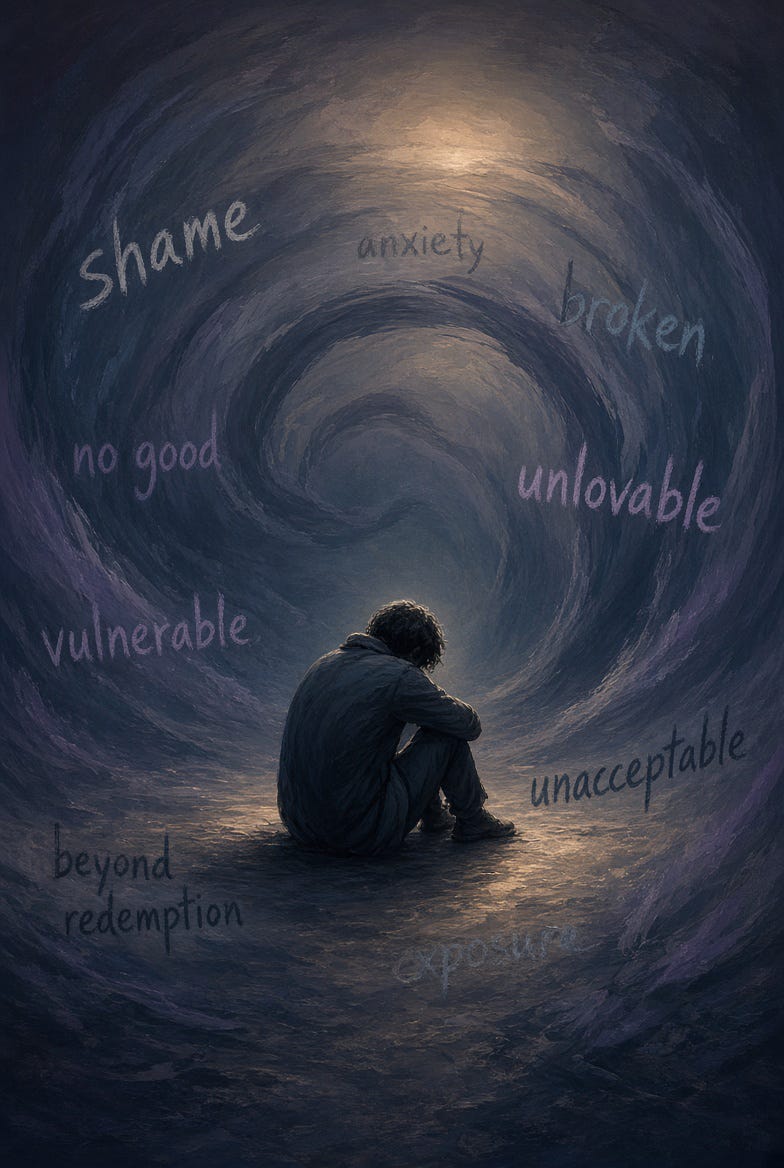
The shame-based individual feels that she must guard this “truth” about herself with all diligence… because if anyone finds out what she’s really like, they will pull away.
(It is beyond the parameters in this article but I will just comment here that the shame-based profile most often has its origins in attachment issues from childhood. Not always, but most commonly. And it is by no means limited to unbelievers.)
A phrase I have heard from more than a few clients over the years is, “I’m afraid that when you find out what I’m really like you’ll be disgusted.”
In every case, their concern is not about something they’ve done, or something done to them. Rather their anxiety comes from what they think will happen if they open up about who they are. (That is, how they see themselves.)
The wording can vary slightly, but the message is always the same with these clients. I can state it like this: When you know who I really am, you will be repulsed by me.
In their mind, he or she is the horrible wound.
A shame wound makes you feel like you live on the brink of vulnerability. One wrong word, one mistake, one behavioral misstep and you will be seen for the broken, misshapen person you really are. You will be exposed. And that possibility of exposure is both terrifying and exhausting to body and soul.
It is easy to imagine the potential for anxiety in the shame-based person. Consider the pressure it puts on someone to carry that kind of burden through life.
Reflect for a moment on the effort it takes to construct a presentable mask to the outside world while feeling so bad about yourself on the inside.
This is not hypocrisy.
Rather, this is someone who believes at all cost that he must hide who he is because he feels wholly unacceptable. He feels broken.
Going through life with a shame wound is the perfect storm from which anxiety can and usually does emerge.
If you are carrying a shame wound, let me offer you some hope.
Let’s go back. Way back.
Do you recall what Adam and Eve did after the Fall? Piteously, they tried to cover themselves. They stitched fig leaves together in the attempt to cover their nakedness.
(There is so much I would like to say at this juncture. But to keep our focus, I’ll move on.)
Why on earth did they do this?
Because they had done something to be ashamed of. Did you notice that? They had done something to be ashamed of. So far, so good.
But in a way both spiritually and psychologically destructive, they internalize the problem. There was a way to do this constructively. After all, they did need to internalize what they had done. They did need to own it.
Unfortunately, they internalized it destructively. (No doubt spurred on by the enemy’s thought poison.)
Adam and Eve take on a self-improvement project. If we cover up, maybe we’ll be okay.
They are now tormented by the very nakedness they exhibited without any qualms whatsoever before, as they walked with God in the Garden (“Who told you that you were naked?”[1]).
With human effort they seek to fix the problem – a folly still practiced today.
There is but one solution. Be done with fig leaves. Quit trying to be enough.
Rather, embrace the admonition of Paul – Put on the Lord Jesus Christ.[2] Let His righteousness clothe you like a robe.
Later, Paul carries the imagery even further saying that if we are in Christ we have clothed ourselves with Christ.[3]
Our shame – both healthy and toxic – are of the old man, the old Adam. If we have been clothed in Christ through redemption we have put on the new man which was created according to God, in true righteousness and holiness.[4]
If you want to begin the conquest of a toxic-shame wound and the anxiety it produces, realize that as a believer you are no longer walking about in fig-leaf couture of your own stitching.
Celebrate the reality that you are now clothed in Christ.
There is no shame to be found in that gracious attire.

[1] Genesis 3:11
[2] Romans 13:14
[3] Galatians 3:27
[4] Ephesians 4:24, which he repeats in Colossians 3:10.

Christians Who Thrive brings together timeless biblical truths with psychological wisdom that equip you to replace the pain and frustration you now carry with personal, spiritual, and relational experiences you long for. ©2026 Growth Resources LLC | Christians Who Thrive. All Rights Reserved.