

As we wrap up this short series let me just briefly revisit what we have seen so far.
First was the holistic prayer of Augustine, which spoke to the importance of knowing ourselves. Next we considered the honest prayer of Teresa of Calcutta which showed us the importance of bringing our whole self to God in prayer, because there can be no intimacy without honesty.
Today we close the series with a prayer from Amy Carmichael. This is a prayer as short as it is significant. A healing prayer. It is a prayer that shows us the much-needed healing of the mind and heart that can come to us in prayer.
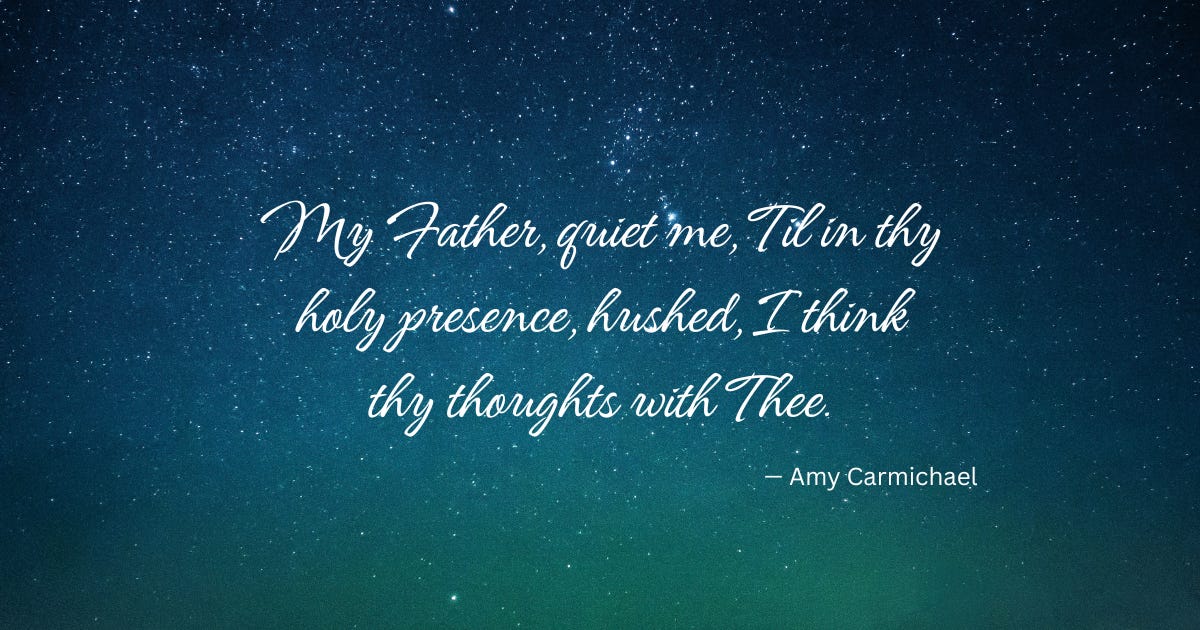
My Father, quiet me, Til in thy holy presence, hushed, I think thy thoughts with Thee. — Amy Carmichael[1]
I want to share a stat from our newly-released book on anxiety: Sixty-four million adult Americans are affected by anxiety. Considering that the adult population of our country rounds to 340 million people, this means 1 in 5 adults in the U.S. suffers from anxiety.[2]
As bad as that stat is, I wish this were where the story ends. It is not.
According to the U.S. government, in 2023, more than 5.3 million adolescents ages 12-17 years (20.3% of adolescents) had a current, diagnosed mental or behavioral health condition.... Anxiety was the most common condition (16.1%), followed by depression.[3]
Stressed parents produce stressed children.
We live in a cacophony of noise today like the world has never seen. As if that is not enough, we’ve managed to find a way to multiply the problem several-fold due to the 3x6 device most are glued to. As anyone who works in mental health can tell you, the latter problem – device attachment – has reached addictive levels.
The greatest English dictionary ever created refers to noise as disturbance made by one or more persons... strife, contention, quarrelling.[4] If these descriptors do not describe our times, I don’t know what does. But it’s worse than that.
Today we have as much noise on the inside as the outside. With my therapy/counseling clients I refer to this internally derived noise as skull chatter. Skull chatter can be an even bigger problem than the din in the outer world.
I can, if I possess the discipline, distance myself from outer noise. It’s harder to get away from the noise within.
How do we deal with all the noise? Amy Carmichael’s prayer has the antidote. We need to be “quieted.” And it is important to understand that we have a part to play in this quieting work of God in our mind and in our heart.
One of my favorite Christian thinkers is that brilliant seventeenth-century French scientist, Blaise Pascal. Pascal tells us: I have often said that man’s unhappiness springs from one thing alone, his incapacity to stay quietly in one room.[5]
Speaking to Pascal’s powerful observation, Susan and I have had the practice of going on a solitude retreat twice annually for several years now. On these retreats the emphasis is quietness. We spend time in Bible reading, prayer, scripture meditation, silence, and reflection. We take one classic to read through together out loud such as The Practice of the Presence of God, The Cloud of Unknowing, or The Pursuit of God.
It is no overstatement to say these twice-annual retreats have become the highlight of the year for us.
What’s interesting, however, is that when I remind them we will be off the week of the retreat, from time to time a client will inquire about the practice of solitude. Quietness. When I explain it, the answers are all of a similar nature and go like this (actual responses):
There’s no way in hell I could do that.
I’d go absolutely crazy.
It would take me a week just to get weaned off social media, and I’m not even sure I could do that.
People seek constant diversion because stillness confronts them with themselves, their mortality, and existential unease.
In this time when many are being eaten alive by noise outside and skull chatter inside, it is imperative that we learn to find quietness.
Psalm 46 offers the perfect remedy, for it is all about stilling our minds and hearts in times of chaos. The Psalm references trouble, fear, natural disasters, war, national and international conflict.
For nine verses the psalmist has been speaking. This changes abruptly in verse 10. God speaks.
Be still, and know that I am God.
Grammatically, this is a command. The opening could just as rightly be translated Quiet! Or Stop! Or Cease striving!
Note carefully that the rest of the verse relays the certainty of who God is and the peace which comes from knowing He is in perfect control of everything. But this certainty stems from that one command... Be still.
We have to first get quiet. We have to be still. We have to stop.
God is not a personal assistant. He will not commune with us on the fly. I am not saying we will lack His presence as we are going through a busy day. But I am saying that if we do not set aside a time of quietness each day to be alone with Him, we are unlikely to experience peace amid all the noise.
The French have a word that sounds as beautiful as it is rich – sangfroid (pronounced säˈfrwä). The word means a composure, a coolness demonstrated in times of danger or under trying circumstances.
It is a part of that very rich Bible word peace.
Is there anything more needed today?
To have it, we must practice quiet. We must have that time daily where we are still. This is when He will freely communicate, when He will whisper to our hearts and minds, know that I am God.
It is when we pray with Amy Carmichael: My Father, quiet me, Til in thy holy presence, hushed, I think thy thoughts with Thee.

[1] This prayer is from the mid-1930s. Ireland’s Amy Carmichael (born 1867) never married. Despite being in physical pain throughout her life, she gave herself to rescuing the forgotten children of India. Victims of the caste system, these boys and girls had been exposed to unimaginable circumstances, including trafficking and slavery. She died in 1951 at the age of 83 and was buried in India. I recommend her many books to our readers.
[2] Michael Ruth, PhD, Anxiety... and how to conquer it.
[3] https://mchb.hrsa.gov/sites/default/files/mchb/data-research/nsch-data-brief-adolescent-mental-behavioral-health-2023.pdf
[4] I am referring to the 20 volume Oxford English Dictionary, 2nd edition, 1991.
[5] Blaise Pascal, Pensées.
Christians Who Thrive brings together timeless biblical truths with psychological wisdom that equip you to replace the pain and frustration you now carry with personal, spiritual, and relational experiences you long for. ©2026 Growth Resources LLC | Christians Who Thrive. All Rights Reserved.