

God is our refuge and strength,
A very present help in trouble.
Therefore we will not fear,
Even though the earth be removed,
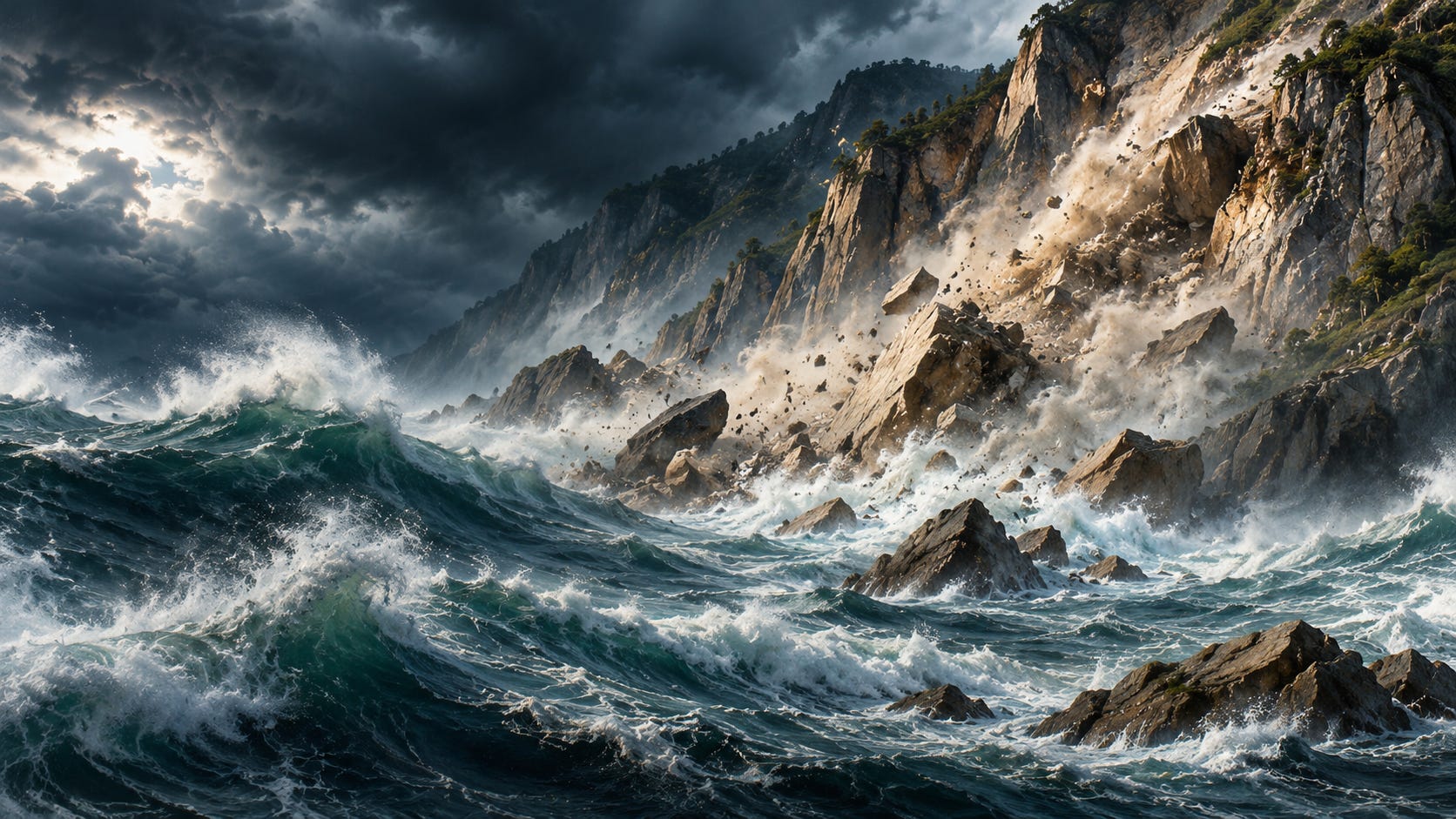
And though the mountains be carried into the midst of the sea;
Though its waters roar and be troubled,
Though the mountains shake with its swelling.
Selah[1]
This is a psalm for those for whom the stable places in life have given way to chaos. Like all the Psalms, it is rich in poetic imagery. Mountains are poetic reference to those places in life you count on to always be there. They are used throughout the Bible to refer to that which is fixed, stable, reliable. Unchanging.
Except when they aren’t.
The sea stands for chaos, danger, uncertainty. Indeed, in all of the ancient Near Eastern world sea is a metaphor for chaos.
Ask Job about the sea.
Human sanity requires a certain amount of stability in life. (This is why stable adults, a stable home, stable patterns are so important to the developmental years.)
When our stable places... our mountains... crumble, when they are carried into the midst of the sea we are at risk.
Some of you are facing this truth right now. Maybe that marriage that you thought was as sure as Gibraltar has crumbled. Perhaps that career that you expected to last to retirement vanished in a day. Possibly the health that was so reliable you scarcely gave it thought has abandoned you in one test result. Or that child you love more than life, now grown, has forsaken you and insists on estrangement.
One way or another, your mountain has been cast into the sea. The stable and reliable has been thrown violently into the midst of chaos.
And you’re left in the tsunami it has brought... the confusion, fear, and anxiety threatening to overtake you. The sorrow, perhaps.
When our life is in chaos, when we are broken and battered, what are we to do?
We lift our eyes to the Storm Treader (more about that later). We cry out to God and anchor in Him.
Look again at v 1: God is our refuge and strength, A very present help in trouble. What do we seek in a storm? We seek refuge. We cannot stop the storm. But we can get out of its destruction. He is our refuge.
Note the second critical word. We often pray God will give us strength. I’m sure that is a fine thing to pray but note the verse offers us much more than that. It says God IS our strength.
Lastly I encourage you to note the phrase “a very present help in trouble.” In Hebrew the word very that is used carries the idea of exceedingly or abundantly. In other words, God is more than ready to help us in turbulent, troubling times.
You might be thinking, “I know that God is with me but somehow it’s making little difference. My mountain has crumbled. It has been thrown into the sea, and I am in chaos. I’m terrified of what’s next and I don’t know what to do.”
I can tell you where I go wrong at such times.
I mistake knowledge for experience. And in such times, the knowledge that God is with me and will help me provides little aid.
Knowledge is not enough.
We need experience. Encounter.
The key lies in verse 10: Be still, and know that I am God.
This verse gives us two imperatives, the first behavioral and the second cognitive.
He tells us to “be still.” The command is to stop. To desist. That’s the behavioral call.
It shows how far we’ve gotten from the spiritual disciplines that we no longer know how to practice solitude. Until we can get quiet, settle down, cease from activity for a brief time ... calm our mind and our spirit ... we will never experience the second imperative.
Know that I am God is the cognitive instruction. This is much more than just head knowledge. It is a knowledge born of experience in the moment in which “deep calls to deep” and God conveys to us that He is in charge. It is then and only then we are able to say, “therefore we will not fear,” as our Psalm says.
As the psalmist says elsewhere: Truly, my soul waits silently for God.[2] Same idea.
Just a couple of points in conclusion. Above, I referred to God as the Storm Treader. I take that straight from Scripture, for Job tells us that God treads on the waves of the sea.[3] If this calls to your mind Jesus walking on the Sea of Galilee to comfort and calm His terrified disciples in the boat, you have it exactly right. He rules the chaos.
Lastly, the Book of Revelation tells us the day is coming when there will be “no more sea.”[4] That is, no more chaos. I say Amen to that!

[1] Psalm 46:1-3
[2] Psalm 62:1.
[3] Job 9:8.
[4] Revelation 21:1.
Christians Who Thrive brings together timeless biblical truths with psychological wisdom that equip you to replace the pain and frustration you now carry with personal, spiritual, and relational experiences you long for. ©2026 Growth Resources LLC | Christians Who Thrive. All Rights Reserved.
Mike and Susan, this spoke to a tender place in my heart. With the holidays approaching, I’ve been feeling the grief of the broken relationships in my family. There’s sadness in realizing that the people and places you hoped would offer security can also be the source of deep hurt. I really like your statement, “Knowledge is not enough.” I can know that God is with me and still find myself caught up in worry and painful memories. Your words remind me to pause and spend time with Him, bringing what I’m feeling into His presence.
Your reminder that God IS our strength especially encouraged me. I often ask Him to help me get through something, but this invites me to rest in who He is. Being still can be difficult when my mind keeps revisiting the past or wondering what comes next.
The picture of the Storm Treader will stay with me. There’s comfort in remembering that the chaos that feels overwhelming to me is still beneath His feet. Thank you both for this reflection and for the kindness you’ve shown me throughout our friendship on Substack. I’m so grateful we connected. ❤️