

As we saw last time when we considered smoke, smoke and mirrors were used by vaudeville magicians to mislead the crowd with misdirection. Magicians use them to this day.
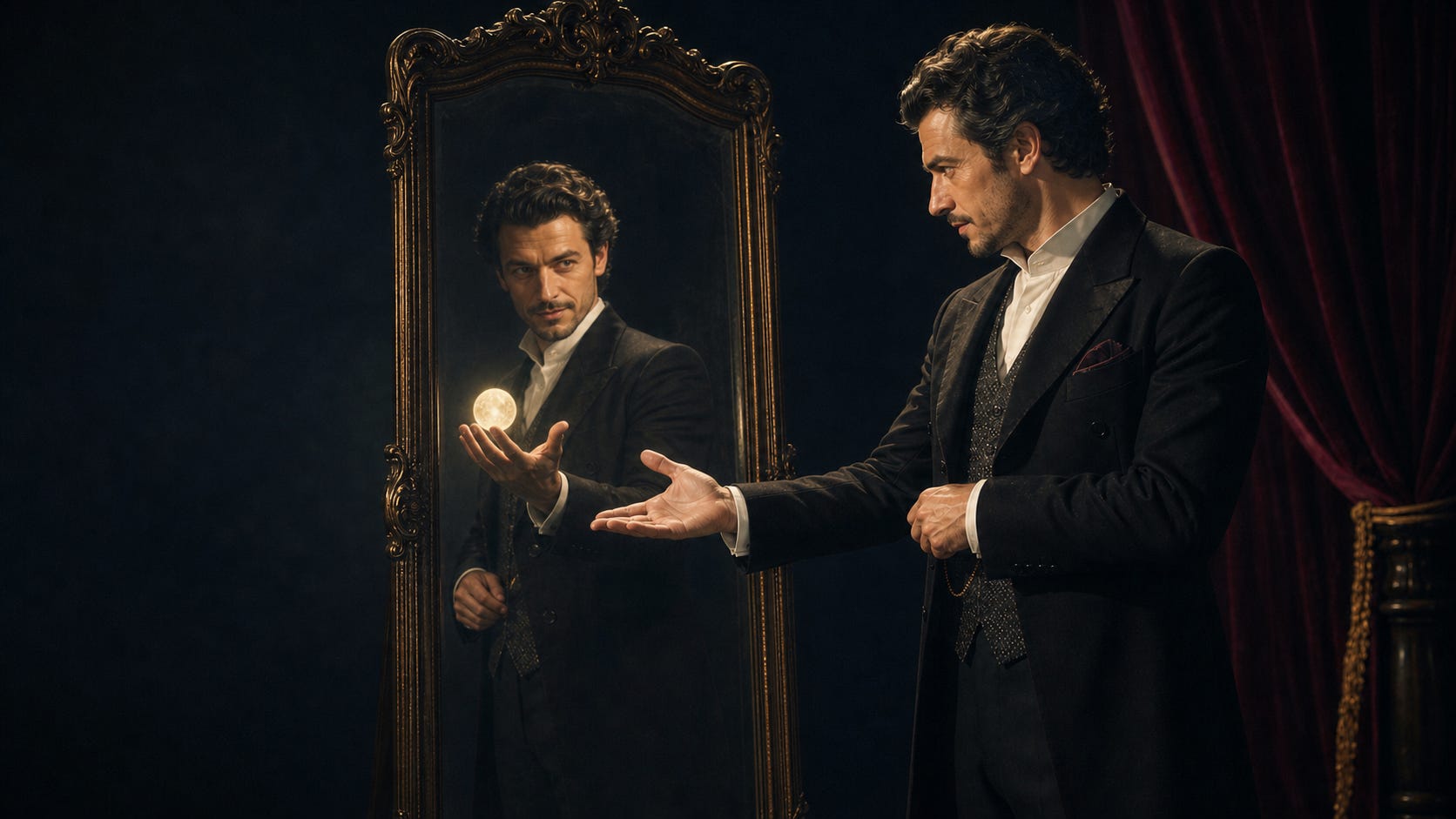
Magic aside, we use a mirror to look at ourselves. It is a useful tool in the physical realm. It is wickedly dangerous in the spiritual.
With smoke, you can’t see. With a mirror you see clearly. But all you can see is yourself. And therein lies the trap.
Proverbs 14:10 tells us, “Each heart knows its own bitterness.”
You know you. You know what you’ve thought. You know what you’ve done. You know the attitudes you have held.
If you can be tricked into keeping your eyes on the mirror... to looking at yourself instead of looking at Christ... you are cooked.
This is a sure road to despair, even depression. It’s a path to being swallowed up by regret and remorse, guilt and shame.
It’s a practice, a habit, that will suck the spiritual energy right out of you.
And, though this is a bit off topic, let me add that mirror-gazing is the chief cause of genuine believers doubting their salvation:
· Have I really believed?
· Is my faith strong enough?
· If I were truly saved would I still struggle with...?
· If I belong to Christ why do I still have doubts?
· Wouldn’t I have more joy?
Virtually all salvation doubts are caused by fixating on the mirror. Look at yourself and most of what you will see is flaws and failure. What you will go away with is doubt.
By way of illustration consider this. In John 3:14 the Master said this: Just as Moses lifted up the serpent in the wilderness, so must the Son of Man be lifted up.
If you know that Old Testament story, consider this. What an error it would have been for one of the Israelites to begin thinking:
· What if I’m too far away? (It’s estimated there were two million people in the migration. Very few of them could actually see the serpent lifted on the pole by Moses.)
· What if I’m not looking in exactly the right direction?
· What if I haven’t prepared myself to look?
· What if this story about a serpent on a stick isn’t true?
· What if it doesn’t work?
What was going on in the mind and life of that particular Hebrew individual wasn’t the issue. The raised serpent was the issue. That is where they were commanded to look.
Here is something we are wise to remember: The closer you look at us – any of us – the worse we look. The closer you look at Jesus, the better, the more beautiful He looks.
Our gaze is to Him. Not at the mirror. The mirror distracts. The mirror redirects.
There is a psychological condition known as body dysmorphic disorder. BDD is a disorder in which an individual is preoccupied with one or more self-perceived flaws or deficits in their physical appearance. Usually these “flaws” are unobservable to others or appear as something only slight and insignificant.
Over the course of my practice I have worked with individuals struggling with body dysmorphic disorder. It is a challenging issue and one which causes a great deal of pain and suffering to those struggling with it.
As you might well imagine, mirrors are the bane of the BDD individual. Mirror checking becomes a behavior that can actually eat up hours of their day.
Why in the world am I telling you this?
Because I have also worked with many Christians who are afflicted with what I call spirit dysmorphic disorder.
These individuals suffer too. And they are just as susceptible to mirrors. Books, podcasts, sermons… even Scripture itself... I’ve seen all of these used in the mind of the Christian with SDD (not an actual diagnosis, merely my working term) as distractions to turn their eyes to themselves and their own shortcomings, and away from Christ and the grace and freedom He has procured for us.
We are told to examine ourselves (2 Corinthians 13:5). We are given no indication whatsoever that God intends us to habitually perform a spiritual autopsy on ourselves.
Jesus has set us free so that we “might have life and have it more abundantly” (John 10:10).
We will never experience this by staring into the mirror of self-scrutiny. It is only a distraction, a misdirection. A painful one to be sure, but a misdirection nonetheless.
It will only serve to make you solipsistic... caught in a cycle that keeps your mind focused on yourself. For the Christian, a solipsistic habit is usually characterized by fear, doubt, worry... anxiety.
Remember, our enemy is called the accuser. He can whisper accusations in your ear all day long about you and about how you fail to measure up. And much of it will be true.
But he is rendered mute when it comes to accusations against our Lord. And it is to Him we look, not ourself.
We must ever hold before our mind’s eye that the message of our redemption in Christ means exactly this: When the Father looked at His Son hanging on the cross, He saw not the spotless Lamb, but me and my sin. Now, when He looks at me He sees not my sin but the spotless Lamb of God. That is the theology of redemption.
That is what the sacrifice of Christ purchased for us. That is why freedom and joy and a restored relationship to the Father is ours by inheritance.
And that is why psychological or spiritual torment no longer has a rightful claim on us.
Though the author had something else in mind, I want to close with a quote that speaks perfectly to this trap of mirror gazing for believers. I encourage you to read these words slowly and deliberately:
This ridiculous foible is perhaps one of our most fatal characteristics; for is there anything more absurd than to wish to carry continually a burden which one can always throw down? to detest existence and yet to cling to one’s existence? in brief, to caress the serpent which devours us, till he has eaten our very heart?*

* Voltaire, in his novel Candide.
Christians Who Thrive brings together timeless biblical truths with psychological wisdom that equip you to replace the pain and frustration you now carry with personal, spiritual, and relational experiences you long for. ©2026 Growth Resources LLC | Christians Who Thrive. All Rights Reserved.
Wow! This is so good. In my more recent years I’ve become more cautious about how many books I’m reading that focus attention on “self-improvement” rather than focusing on Jesus as the transforming author of my journey toward eternal righteousness. I love the mirror analogy you’ve applied (and am a BIG fan of the working term “SDD”)